

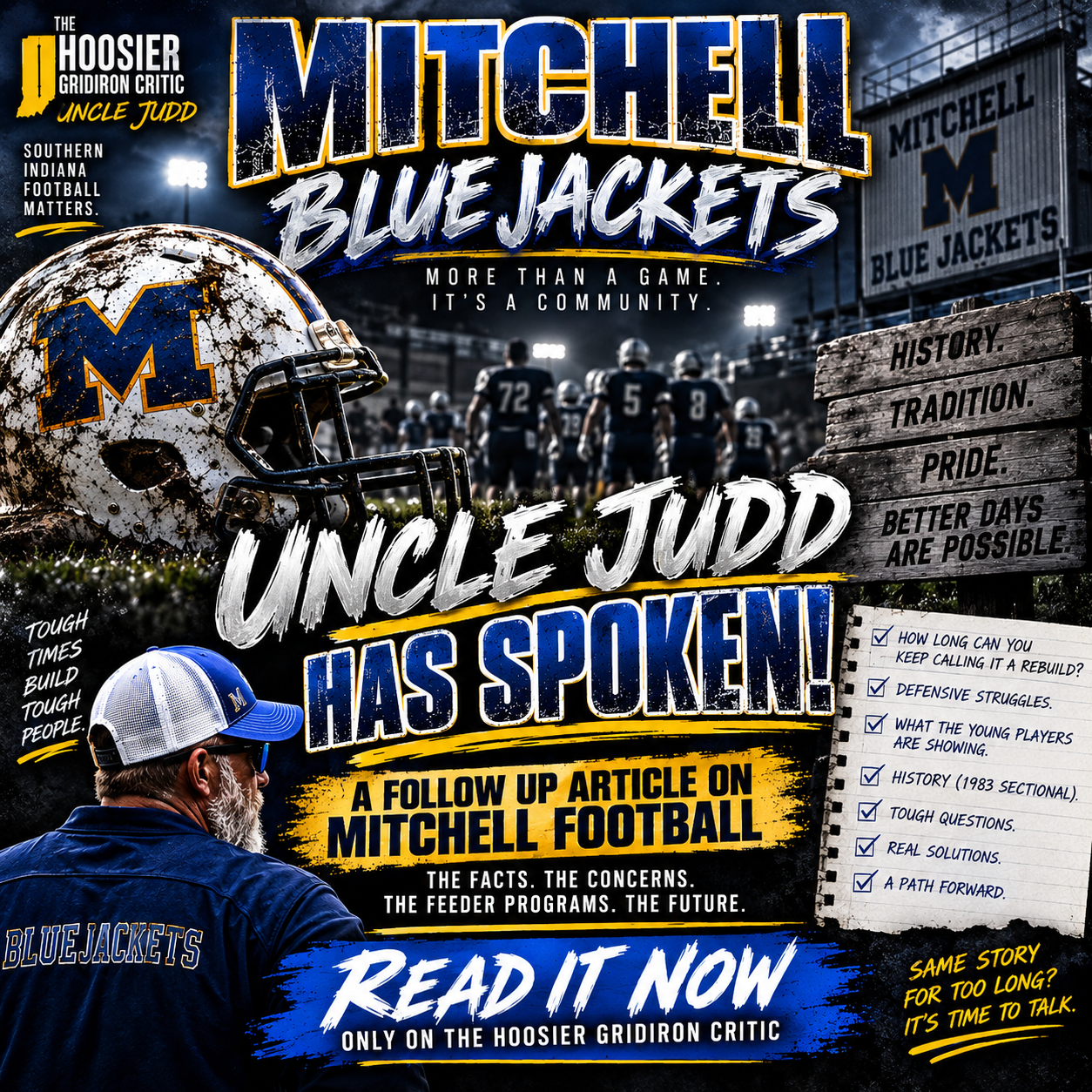
MITCHELL BLUEJACKETS FOOTBALL
The Uncle Judd Archive: A Rebuild Under the Microscope
By Uncle Judd | The Hoosier Gridiron Critic
Few programs have generated more discussion during the first three weeks of the 2026 season than the Mitchell Bluejackets.
And there is a reason for that.
Mitchell entered the season with a new head coach, renewed expectations and plenty of talk about changing the culture surrounding Bluejacket football.
Three games later, Mitchell sat 0-3.
Lafayette Central Catholic 63, Mitchell 6.
Springs Valley 64, Mitchell 24.
West Washington 73, Mitchell 6.
Through three games, Mitchell had been outscored 200-36 and was allowing an average of 66.7 points per game.
But if you have followed Uncle Judd from the beginning, you know this story did not start with the scoreboard.
It started with questions about how Mitchell planned to rebuild its football program.
And those questions have only gotten louder.
THE ORIGINAL PROGRAM BREAKDOWN
Bobby Owens Arrives With Expectations
When Bobby Owens took over Mitchell football, one of the biggest reasons for optimism was his defensive background.
That mattered because Mitchell did not simply need somebody to manage a football team.
The Bluejackets needed rebuilding.
The original Uncle Judd Program Breakdown raised several questions before the season ever got rolling.
Was Mitchell going to become fundamentally stronger on defense?
Would the new staff have enough experience?
Would coaching decisions be based strictly on qualifications and what was best for the football program?
Would Mitchell finally begin developing a clear identity?
And most importantly:
Would things actually look different on Friday night?
Those were concerns and questions raised in Uncle Judd's original analysis — not declarations that the season had already failed.
The Week 2 follow-up graphic preserved the central themes from that original breakdown: Owens' defensive background being a major selling point, concerns about defensive readiness, questions surrounding staff experience, concerns about whether qualifications were being prioritized and larger questions about where Mitchell was headed in 2026.
At the time, they were questions.
Then the season started.
WEEK 1
THE HYPE TRAIN MAY ALREADY BE OFF THE TRACKS
Mitchell opened the season against Lafayette Central Catholic.
This was supposed to provide the first real look at the Bobby Owens era.
Instead, Mitchell found itself trailing 56-6 in the first quarter when Uncle Judd published his game-night reaction.
That changed the entire conversation.
Nobody was declaring Bobby Owens a failure after one football game.
Doing that would have been ridiculous.
But there was also no way to pretend what was happening wasn't concerning.
Mitchell was supposed to look bigger.
Stronger.
More physical.
More disciplined.
Most importantly, Mitchell was supposed to begin establishing a new identity.
Instead, the Bluejackets were being completely overwhelmed.
And that brought the preseason conversation right back to the front.
We had talked about Owens' defensive background.
We had talked about strength and conditioning.
We had talked about physicality.
We had talked about changing the culture.
And Uncle Judd made one point very clear:
Culture eventually has to show up on Friday nights.
The final score would be Lafayette Central Catholic 63, Mitchell 6.
It was an ugly beginning.
But Uncle Judd wasn't ready to bury the new coaching staff after one game.
The message was simpler:
The honeymoon was over.
Now we needed answers.
SOMETHING POSITIVE WAS HAPPENING TOO
While the varsity was struggling, there was another Mitchell football story worth watching.
The Mitchell Junior High team coached by Nick Doub went on the road to Crawford County and came home with a win.
That mattered because Doub had been working with many members of that group for years.
The larger point wasn't that a junior-high victory somehow erased what happened at the varsity level.
It didn't.
The point was development.
Young players being coached consistently.
Players learning together.
A group growing through multiple seasons instead of starting over every year.
That became an important part of Uncle Judd's Mitchell coverage because rebuilding a high school football program cannot begin when players become freshmen.
It has to begin years earlier.
The original reaction specifically praised Doub's group for winning at Crawford County and noted the continuity of having coached many of those players since elementary-school ages.
That created an interesting contrast.
The varsity was struggling badly.
But there appeared to be young players coming through the system who had spent years playing together.
That was something worth watching.
WEEK 2
MITCHELL GETS HAMMERED AGAIN
After the Week 1 loss, Mitchell desperately needed a response.
Instead, Springs Valley defeated Mitchell 64-24.
And suddenly the issues discussed before the season didn't look theoretical anymore.
The Week 2 follow-up asked:
Same concerns. Same results. How much longer?
The central criticism was especially difficult to ignore because defense had been one of the selling points of the new regime.
After two games, Mitchell had surrendered another enormous number of points.
The graphic built around the Week 2 reaction deliberately pointed back to the Week 1 Program Breakdown:
Defensive background was the selling point.
Defensive readiness had been questioned.
Staff experience had been questioned.
The overall direction of the rebuild had been questioned.
Then came two games where Mitchell couldn't stop either opponent.
At that point, Uncle Judd's criticism became stronger.
Not because two losses meant Owens couldn't eventually succeed.
But because when you sell a rebuild around defense, physicality and culture, surrendering huge numbers of points immediately forces people to ask whether the rebuild is actually taking hold.
BUT DON'T FORGET THE PLAYERS
One thing remained important throughout the Mitchell coverage:
The players are not the enemy.
These are high school kids.
They are walking onto the field every Friday night representing Mitchell even when things are going badly.
They are practicing all week knowing they might be walking into another extremely difficult game.
They are taking the hits.
They are hearing the criticism.
And they are still putting the uniform on.
That deserves respect.
The Week 2 Dirty Dozen coverage specifically called attention to Mitchell's defensive struggles while also telling the players:
We see your heart. Keep fighting.
Accountability and appreciation can exist at the same time.
Uncle Judd will criticize coaching decisions.
He will question program direction.
He will examine development.
But the kids who continue showing up deserve credit for continuing to fight.
WEEK 3
NOW THE PROBLEM IS BIGGER THAN ONE BAD NIGHT
Mitchell entered Week 3 at 0-2.
West Washington made things even worse.
West Washington 73, Mitchell 6.
That moved Mitchell to:
0-3
200 points allowed
36 points scored
66.7 points allowed per game
At that point, Uncle Judd's Mitchell coverage began transitioning away from simply asking what had gone wrong on Friday night.
The bigger question became:
What needs to change?
The planned follow-up identified several issues that needed examination:
Is the rebuild working?
Where does Mitchell go from here?
Why has the defense struggled this badly?
Would focusing heavily on JV development make sense?
What are Mitchell's feeder programs showing?
Who are the players developing in the pipeline?
What can Mitchell learn from its football history?
What specifically needs to change?
And most importantly:
Is there a realistic path toward a stronger future?
Those are bigger questions than whether Mitchell wins next Friday.
They are program questions.
THE FEEDER PROGRAM MATTERS
One theme has appeared again and again throughout Uncle Judd's Mitchell coverage:
You cannot fix varsity football by focusing only on Friday nights.
The pipeline matters.
Youth football matters.
Junior high football matters.
Coaching fundamentals matters.
Strength development matters.
Learning the same terminology and basic system matters.
Creating expectations before athletes ever reach high school matters.
Mitchell does appear to have some young players who have been playing together for years.
That is something worth building around.
But continuity alone isn't enough.
The question is whether every level is preparing athletes for the kind of football Mitchell ultimately wants to play at the varsity level.
That means the youth program, junior high program and varsity staff eventually need to function as parts of the same development process.
Not three separate football worlds.
THE NICK DOUB QUESTION
Nick Doub became part of the Mitchell discussion because of his long involvement with many players currently coming through the younger levels.
There are supporters of that continuity.
There have also been concerns raised regarding youth and junior-high coaching structures, parent involvement and whether coaching decisions at developmental levels always prioritize what is best for every player.
Those concerns deserve examination without turning rumor into fact.
What can be said is that Doub has spent years with many members of this group and that his junior-high team produced an early-season road win at Crawford County.
What happens with those players as they move toward varsity football may tell us quite a bit about whether Mitchell's pipeline is improving.
THE BOBBY OWENS QUESTION
Three games do not define a coaching career.
That needs to be said clearly.
Bobby Owens deserves time to implement his program.
He deserves an opportunity to develop players.
He deserves an opportunity to make adjustments.
But patience cannot mean avoiding accountability.
If defense was one of the major reasons for optimism surrounding Owens, allowing 200 points through three games demands examination.
If physicality was supposed to improve, Mitchell has to become harder to push around.
If culture was supposed to change, eventually that culture has to become visible through preparation, discipline and competitiveness.
And if the program is truly rebuilding, then supporters need to see progress even when that progress doesn't immediately show up in the win column.
Maybe that's fewer missed assignments.
Maybe that's tackling better.
Maybe that's young players developing.
Maybe that's the JV team improving.
Maybe that's closing the scoring gap.
Maybe that's simply looking more organized every Friday night.
But something has to move forward.
THIS IS BIGGER THAN THE HEAD COACH
It would be easy to put everything on Bobby Owens.
That would also be lazy.
A struggling football program is almost never created by one person.
It involves years of development.
Participation numbers.
Youth football.
Junior-high football.
Strength programs.
Coaching continuity.
Community expectations.
Administrative support.
Athlete retention.
And sometimes the overall culture surrounding athletics.
If Mitchell wants sustained success, the entire football structure needs to be examined.
Not simply the varsity head coach.
WHAT MITCHELL NEEDS NOW
Mitchell needs stability.
It needs development.
It needs players believing that the work they're doing today is building toward something.
It needs qualified people teaching fundamentals throughout the pipeline.
It needs younger athletes wanting to become Bluejackets.
It needs the junior-high level connected to the varsity vision.
It needs strength and physical development.
And eventually it needs something that has been missing during the opening weeks of 2026:
Evidence.
Evidence that the rebuild is working.
Not hype.
Not promises.
Not Facebook posts.
Not slogans.
Progress.
UNCLE JUDD'S CURRENT VERDICT
I am not ready to declare Bobby Owens a failure.
Three games would be an absurdly small sample size to make that judgment.
But I'm also not going to pretend Mitchell's start isn't alarming.
0-3.
Outscored 200-36.
That is not a minor problem.
That is a football program giving us every reason to examine exactly where it is and where it is going.
And that's exactly what The Hoosier Gridiron Critic is going to do.
But I also want every Mitchell athlete reading this to understand something.
If you're still showing up...
If you're still practicing...
If you're still walking onto that field...
If you're still fighting when the scoreboard isn't going your way...
Uncle Judd sees you.
Keep going.
Because the future of Mitchell football isn't sitting in an office.
It's wearing helmets.
It's lifting weights.
It's playing junior high football.
It's learning how to tackle.
It's learning how to lose without quitting.
And eventually, if Mitchell gets this right, those kids are going to learn how to win.
The question surrounding Mitchell football isn't whether the past three weeks were bad.
We already know the answer to that.
The question is:
What happens next?
Because tough times don't automatically build strong programs.
What you do during those tough times does.
— Uncle Judd
The Hoosier Gridiron Critic
Southern Indiana Football Matters.